Stem separation, mastering and generation, Suno and Udio label deals, the GEMA ruling and what AI means for Barcelona clubs and festivals.
By Daniel Campoy
Artificial intelligence is now part of everyday electronic music. It sits in the software DJs use to pull vocals out live, in automated mastering services and in generators that build full songs from a single prompt. At the same time, courts and record labels are setting the rules. Here is where things stand in November 2026 and what it means for Barcelona’s clubs and festivals.
At a glance
In the booth: real-time stem separation is now a standard feature in Serato, rekordbox, VirtualDJ and djay.
In court: Universal and Warner have settled with Udio, Warner with Suno, and a Munich court ruled for GEMA against Suno at first instance.
In the EU: since August 2026 the AI Act’s transparency obligations on AI-generated content, including audio, apply.
Which AI tools are used in production and live
It helps to separate three very different uses, because the legal debate does not hit them equally.
Stem separation. AI models split a finished track into vocals, drums, bass and melody. This is the tool that has changed DJing the most: instant acapellas or instrumentals without the original stems. According to Digital DJ Tips, the main DJ platforms (Serato DJ, rekordbox, VirtualDJ and djay Pro) all offer real-time separation, with differences in quality and CPU load.
Assisted mastering and mixing. Services and plugins analyse a track and suggest EQ, compression and final loudness. They are handy for demos, edits and quick sessions; on professional releases they usually complement rather than replace an engineer.
Generation. Platforms such as Suno or Udio create complete songs, vocals included, from text. This is the most contested use, because these models are trained on large volumes of recorded music.
How DJs use them
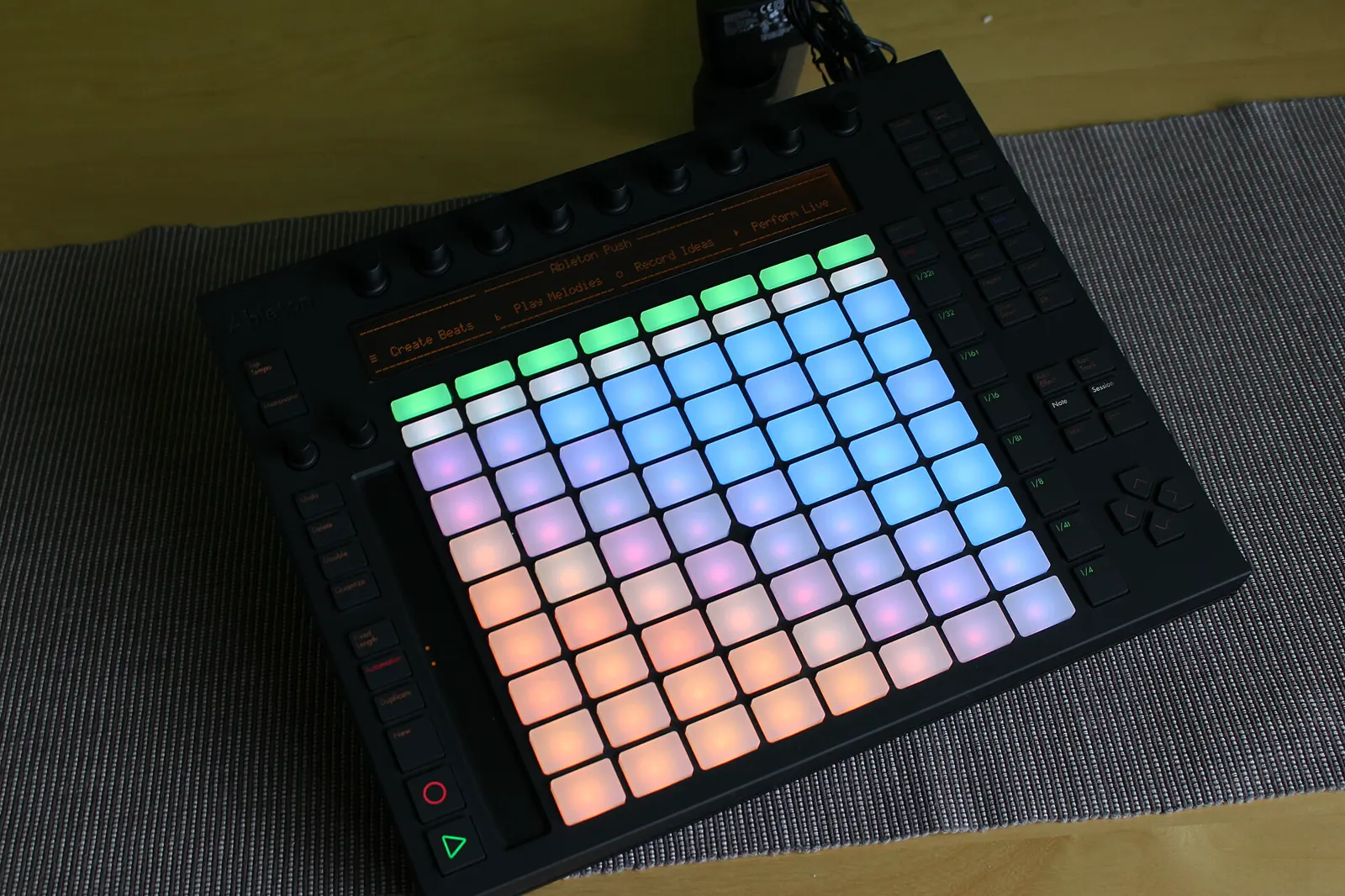
Controller for electronic music production and live sets. Image: GeschnittenBrot / Wikimedia Commons (CC BY-SA 2.0)
In practice, AI enters the booth mainly as a live editing tool: dropping the vocal from one track to layer it over another, isolating a bassline or building cleaner transitions. Outside the booth, many producers use it to prepare edits, clean up old recordings or test ideas before going into the studio.
Two caveats matter. First, separating a track’s stems does not change who owns its rights; playing it in a club still depends on the venue’s public performance licences. Second, releasing or selling an edit built on stems extracted from someone else’s work requires the rights holders’ permission, just as it did before AI.
The copyright debate: Suno, Udio and the labels
In 2024 the US recording industry sued Suno and Udio for training their models on protected recordings. Since then, the dispute has partly been resolved through deals:
Universal and Udio announced a settlement in October 2025 that ends the litigation and plans an AI music platform built on licensed catalogue, according to Music Business Worldwide. Figures were not disclosed.
Warner and Udio reached a similar deal in November 2025 (Claims Journal / AP).
Warner and Suno settled the same month with a partnership that, among other things, requires users to pay to download songs from the platform (Claims Journal / Bloomberg).
Sony was still pursuing both companies at the end of 2025, per Digital Music News. The current status of the Universal–Suno case is unconfirmed.
In Europe, the key precedent is German. On 31 July 2026 the Munich Regional Court ruled for collecting society GEMA against Suno in a case over six works, including «Forever Young» and «Daddy Cool», according to GEMA’s statement. It is a first-instance ruling and can be appealed. The specific position of Spain’s SGAE on these cases is unconfirmed.
What EU rules require
Article 50 of the EU AI Act sets transparency obligations that apply from 2 August 2026: audio, images or video generated or manipulated with AI must be identifiable as such, according to Heuking. The European Commission has also published a voluntary code of practice on marking and labelling such content. For systems already on the market before that date, the technical marking deadline has been extended to 2 December 2026.
For artists and promoters, the practical takeaway is simple: if a promo piece or a track was generated with AI, it is prudent to say so.
What it means for Barcelona festivals and clubs
Barcelona has one of Europe’s most active electronic music scenes, and AI raises concrete questions for it:
Programming: sets that remix stems live are already common; what is new is the chance of fully AI-generated tracks turning up. Promoters can ask artists for transparency just as they ask for technical riders.
Rights: venue public performance licences remain the foundation. How a generated track with no identifiable human author fits into royalty distribution is still unresolved.
Marketing: posters, videos and ads made with AI fall under the EU transparency obligations.
Opportunity: the technology opens new formats, such as generative visuals or interactive experiences, without replacing what defines a club: the DJ’s judgement and people on the dancefloor.
Technology and music at DEXT FORCE
At DEXT FORCE, the daytime conversation on AI, startups and finance meets the after party at night, an electronic music festival where these tools are seen live. If you work in music, tech or rights, see the programme’s focus in the sessions or request a meeting via meetings.
Frequently asked questions
Is it legal for a DJ to use AI stem separation in a club?
Using the feature live is just another technical tool. What determines whether a track can be played is the venue’s public performance licensing, not the technology used to manipulate it.
Have the labels beaten Suno and Udio?
In the US, most fronts have closed with licensing deals rather than rulings. In Germany, GEMA beat Suno at first instance in July 2026; the decision can be appealed.
Do you have to disclose that a song was made with AI?
Since August 2026 the AI Act requires AI-generated or manipulated audio to be identifiable as such, with nuances and exceptions. When in doubt, label it.
This article is for information only and is not legal advice.


 By Daniel Campoy