EBA warns stablecoins underpin DeFi and open a route around MiCA
The EBA warns stablecoins underpin DeFi and open a route around MiCA. What it asks the Commission and what it means for crypto and fintech in Spain.
By Marc Nieto
The European Banking Authority (EBA) warns that stablecoins have become the backbone of decentralised finance (DeFi), and that this opens a route around MiCA. In a report published on 25 November 2026, the supervisor asks the European Commission to consider extra requirements for crypto-asset service providers (CASPs) that give access to DeFi, especially to lending protocols.
Key takeaways
What happened: the EBA publishes its report on the use of e-money tokens (EMTs) and other stablecoins in DeFi.
The finding: stablecoins provide the liquidity, collateral and settlement for most DeFi lending and trading.
The risk: consumers can lose everything, and DeFi lets holders earn yield on EMTs even though MiCA bans paying interest on them.
The ask: that the MiCA review consider new obligations for exchanges and apps that route clients to DeFi.
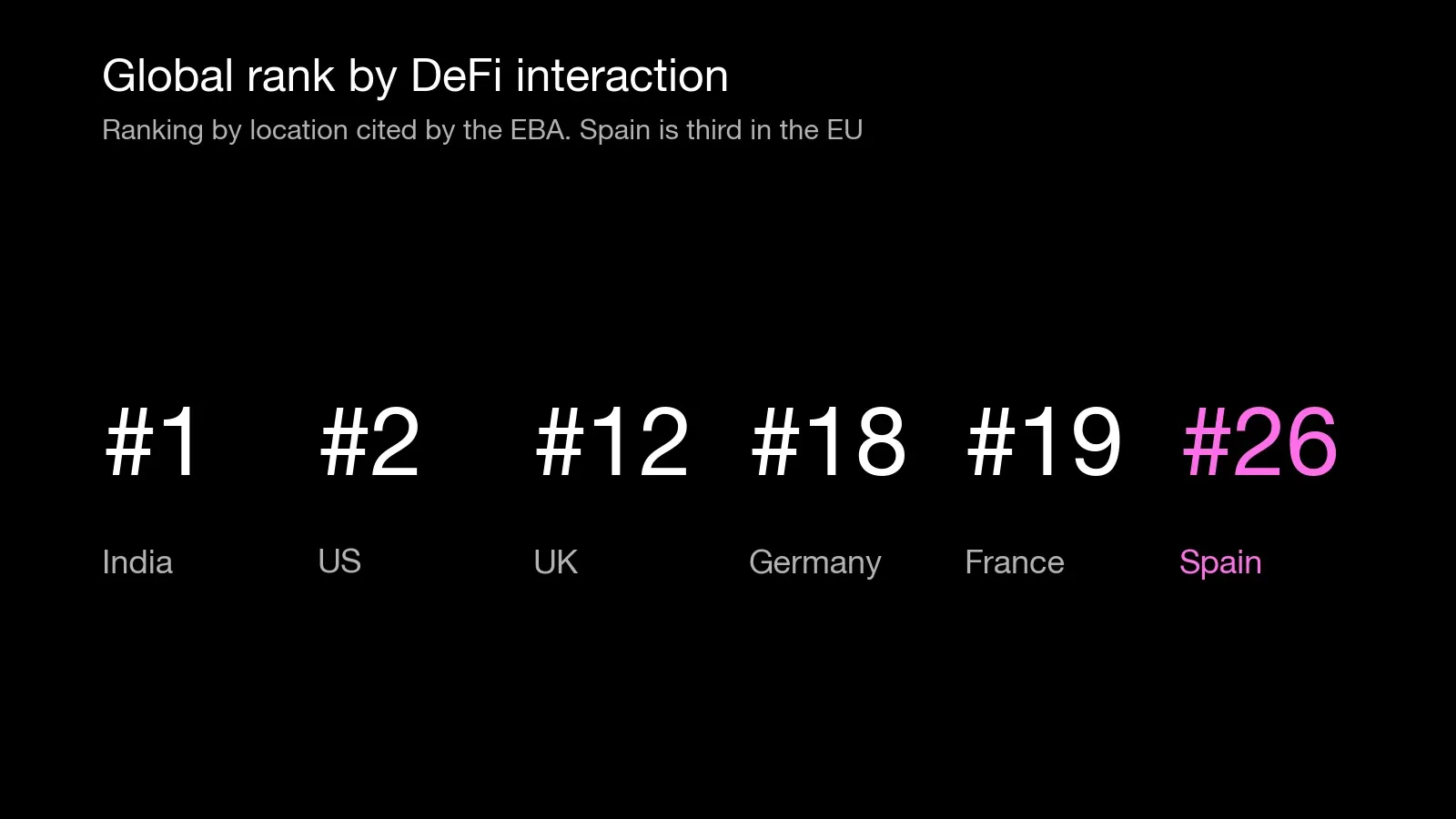
Spain: third in the EU for DeFi interaction, but 26th worldwide.
What the EBA report says
The EBA concludes that stablecoins, including some EMTs issued under a MiCA licence, are central to the DeFi ecosystem: they provide liquidity, serve as collateral and settle trading and lending activity.
The report’s data help size the trend:
37 authorised EMTs: the number in ESMA’s MiCA register as of 30 July 2026.
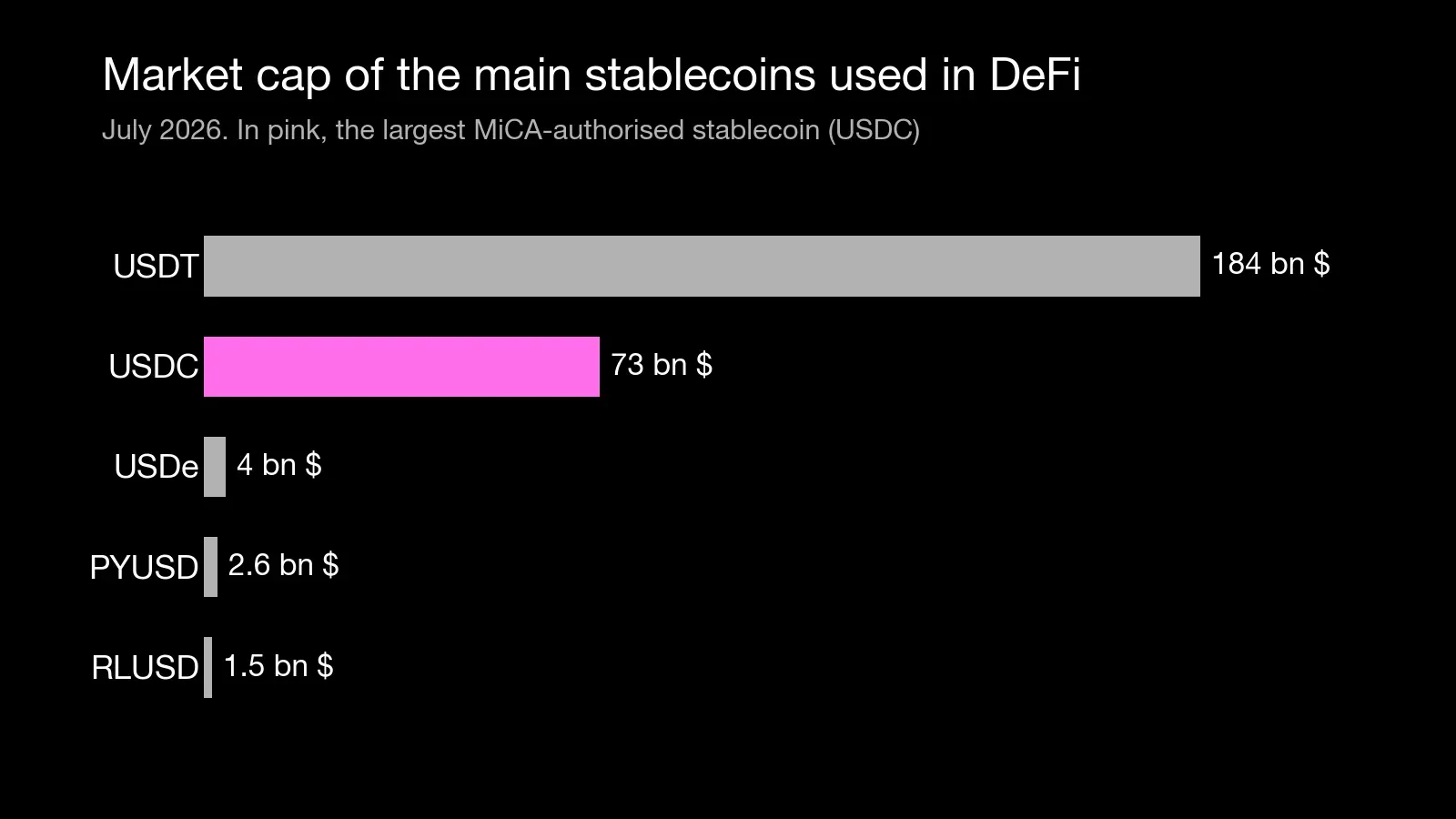
USDC leads among authorised tokens: it is the most used EMT on the decentralised exchanges and lending protocols analysed, with a market cap of 73 billion dollars.
USDT dominates overall: at 184 billion dollars, it is the most used stablecoin in DeFi despite lacking MiCA authorisation, like USDe.
The market has cooled: total value locked in DeFi halved from its autumn 2025 peak to 75 billion dollars in July 2026.
USDT is more than twice the size of USDC, the largest MiCA-authorised stablecoin. Data from the EBA report, July 2026.
Why it matters: consumers and regulatory arbitrage
DeFi use among EU consumers is still limited, but the EBA sees access getting easier for three reasons: CASPs offer access and DeFi-linked products, 42% of European-based investors expect to engage with DeFi by 2028, and artificial intelligence, including AI agents, lowers the barrier to entry.
The consumer risks it flags are specific: inadequate risk disclosure, highly leveraged positions, loaned stablecoins that are not repaid and operational failures. In the worst case, consumers lose everything they invested. Those problems can also spill over to EMT issuers and to the CASPs acting as gateways.
The second front is regulatory arbitrage. MiCA bans paying interest for holding EMTs, but in DeFi they can earn yield by being lent out. On Morpho, the lending protocol with the widest range of EMTs, depositing USDC returned an average of 4.15% a year in July 2026. The EBA also warns that DeFi can be used to offer tokens without MiCA authorisation in the EU.
The gap comes from the regulation itself: MiCA excludes services provided without an intermediary in a fully decentralised manner, and crypto lending is not among the services it covers.
What the EBA asks the European Commission
The EBA reiterates the recommendation it made in the Commission’s consultation on the MiCA review: assess whether CASPs facilitating access to DeFi, in particular lending protocols, should meet additional requirements. It is not a new rule. It is technical advice, and the decision rests with the Commission and the legislative process that follows.
Germany, France and Spain lead the EU in DeFi interaction, though far behind India, the US and the UK.
What it means for the Barcelona ecosystem
Spain is the third EU country for DeFi interaction, according to the data cited by the EBA. For Barcelona’s fintechs, exchanges and crypto startups the message is clear: a MiCA licence does not cover everything offered to the customer. Anyone integrating DeFi lending, stablecoin yield or AI agents that operate on protocols should prepare for more disclosure and risk-control obligations.
There is also an opportunity. If the EU asks more of the gateways, compliance, custody and DeFi risk-analysis solutions gain value. It fits with Spanish banks’ move towards their own stablecoin, covered in our piece on Project Faro by Santander and BBVA, and with the list of MiCA exchanges authorised by Spain’s CNMV. For users, the advice is still to know where their funds sit: see our guide to crypto self-custody. This is general information, not financial advice.
DEXT FORCE brings founders, investors, banks and regulators together in Barcelona to talk crypto, AI and finance. To be first to hear about the next edition, join the waitlist.
FAQ
Does the EBA ban DeFi or stablecoins?
No. The report analyses risks and recommends that the European Commission study additional requirements for CASPs giving access to DeFi. It changes no rule.
Can you earn interest on stablecoins in the EU?
MiCA bans issuers and CASPs from paying interest for holding EMTs. The EBA warns that lending them on DeFi protocols generates similar returns and sees this as a regulatory arbitrage risk.
Which stablecoins have MiCA authorisation?
As of 30 July 2026, ESMA’s register listed 37 EMTs, including Circle’s USDC and EURC. USDT and USDe are not MiCA-authorised.
 By Marc Nieto